
The computer (Word, Excel, Canva – fill in your favourite pet peeve) just won’t do what I ask it to!
How many times have we uttered that phrase in frustration and helplessness? I’m thinking in particular of those who weren’t born with a mouse in their hand – that is, those born generally before 1995. One might think that AI is going to change all that.
Can we be sure of that?
Let’s try to sort this out: to start with, five minutes should be enough.
A baby learns to recognise a glass of water in just two or three impressions. For a human child, seeing a common object several times is enough to identify it as such. An AI will need several hundred thousand iterations to be able to recognise a glass. A whole system will be put in place to enable it to distinguish between glasses. This knowledge will be virtually impossible to transfer to other tasks.
Indeed, the artificial intelligence we have today is linked to specific tasks. In specialist terminology, human intelligence—our benchmark—is referred to as GI, or general intelligence. This is referred to as AGI (Artificial General Intelligence). This category of intelligence implies ease of conceptualisation, the ability to transfer skills from one task to another and, generally speaking, the flexibility humans demonstrate in dealing with unforeseen situations. In fact, mental flexibility is the gateway to intelligence. The current concept of artificial intelligence is a term that became established in research in the 1950s. Unfortunately, it is the source of many misunderstandings today.
Let’s be clear: AI is not intelligence… of the human kind. Artificial intelligence, as found in machines, is of a different nature. It enables, for example, the storage of massive amounts of information and the execution of operations that can be described as ordered sequences (algorithms) at staggering speeds.
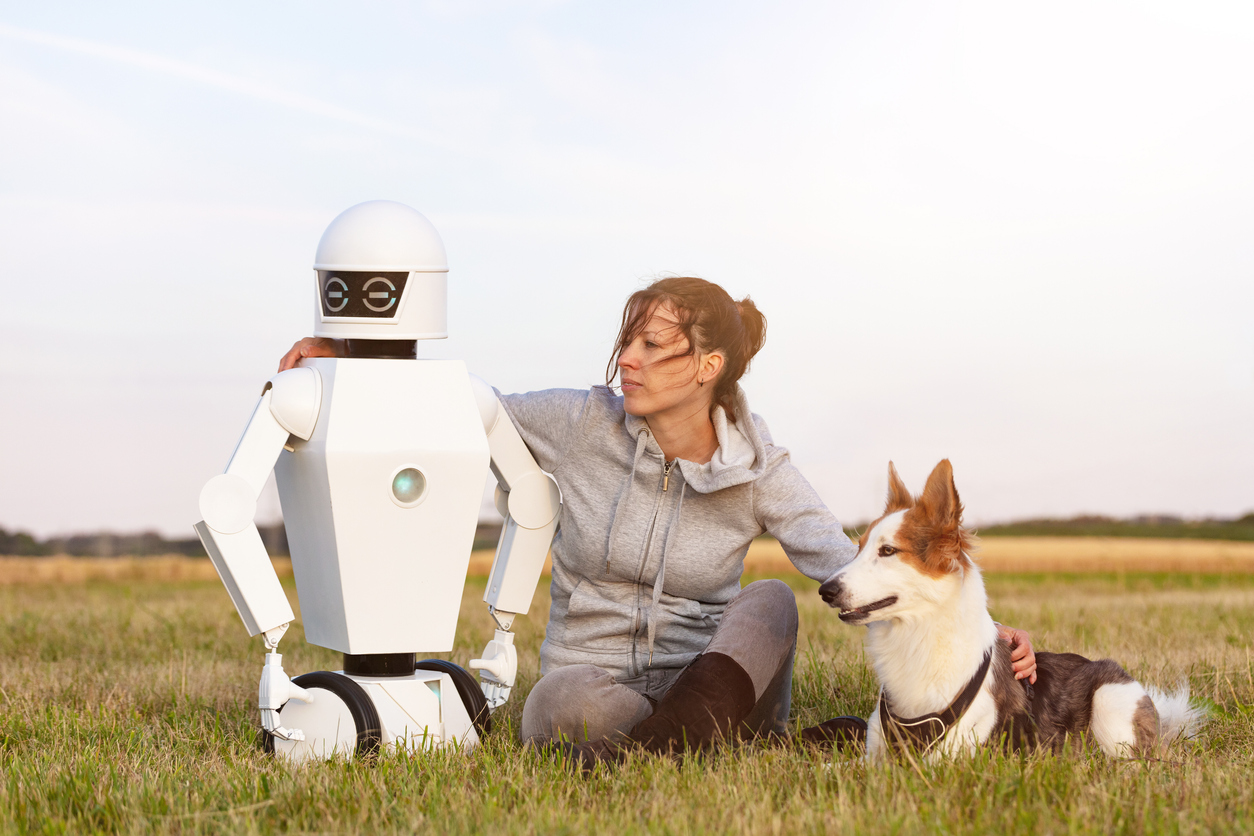
For our societies, which are obsessed with quantification and estimates and averse to risk, the ability to count, calculate and anticipate is remarkable. Robotics expert Kate Darling compares this new capability to the phenomenal contribution made by the domestication of the buffalo in Mesopotamia, which ushered in the agricultural era some 25 centuries ago. Indeed, this is very much a matter of power within a defined scope of action. The buffalo, as an autonomous agent, provides power incomparable to that of humans within the strict scope of the tasks assigned to it. In essence, AI enables a human to plough through a field of data much faster and more deeply. However, the human who programmes it will always need to be involved in setting the objectives, defining the scope and harnessing the plough. Thus, in her latest book, “The New Breed: What Our History with Animals Reveals about Our Future with Robots”, Kate Darling invites us to think about robots and AI based on our experience with animals, rather than on our reading of science fiction. Let’s be clear: Asimov’s three laws of robotics are not translated into code in reality, because the method of applying general principles to specific situations does not work for AI. The argument is convincing.
Let us rephrase this for clarity: artificial intelligence is a form of intelligence that is not human. Let us consider pets to illustrate this point. Whilst it may seem to run counter to experience and common sense to regard them as lacking in intelligence, it would be no less questionable to attribute human-like intelligence to them. The same reasoning applies to machines. The logic inherent in a computer is different from our own. Ergo, ‘it never does what I want… as long as I assign tasks to it in the same way I would for a human’! The challenge for UX designers lies in particular in facilitating this translation of human users’ needs into specifications that can be understood and carried out by a machine.
Our methodology is based on this observation. We always employ a hybrid approach to ensure that the conceptual ‘plough and oxen’ remain properly aligned. With this in mind, results obtained from large-scale data collections and processed using machine learning have a special status that must be taken into account when converting them into insights.